On Staying Honest About AI
An attempt to write about AI from inside the deployments, without evangelism, without refusal, and without the comforts of pretending you aren't already participating.
A few months ago, I was on a call with a team at a large company. We were walking through a deployment, the kind of project I do a lot of now, where a tool I help build gets pointed at a problem that, until very recently, was solved by a room full of people. The deployment was going well. The numbers were good. Somewhere in the middle of the conversation, one of the senior people on their side, who had been mostly quiet, said something I keep thinking about. She said, we used to have a team for this.
She didn't say it with anger. She didn't say it as a complaint. She said it the way you'd note the weather. The team was gone. The work was being done. The math worked out. Everyone on the call moved on to the next agenda item, including me.
I want to be honest about that moment, because I don't think most writing about AI right now is honest about moments like it. The boosters skip past them on the way to a chart about productivity gains. The doomers freeze them into a single frame and use them as proof that the whole enterprise is wicked. Neither of those readings is quite right, and I think the gap between them is where a lot of thoughtful people are getting stuck.
So this is an attempt to write from inside the gap. Not to convince anyone of anything in particular. Just to lay out what it actually looks like, from where I sit, and to make a small case for a posture toward all of this that doesn't require either evangelism or refusal.
I.
I deploy AI systems for a living. That's the disclosure that should come first, because most of the people writing about AI on the internet don't. They write about it from the outside. From the trade press, from the academy, from the comment section, from the venture capital side of the table, from the labor side of the table. All of those views are useful. They are also incomplete in ways the people holding them are not always positioned to see.
I work with attorneys, in-house legal teams, and federal agencies on getting AI tools into legal workflows. Document review, due diligence, contract analysis, large-scale evidence work. I have spent the last few years watching what these tools do when they actually meet the work. I have watched them succeed and I have watched them fail, and I have watched the people on the receiving end of both.
So when I say I want to talk about AI honestly, I am not coming to this conversation as someone who needs to be persuaded that AI is real, or that it is here, or that it is doing what it is doing. I am coming as someone who has watched the team in that conference call disappear, and who participated in the disappearance.
That participation is worth naming. The move I see most often from people in my position is to talk about AI as if it is happening to them too. As if we are all just bystanders watching the future arrive. We aren't. Some of us are building it. Some of us are selling it. Some of us are deploying it into rooms where people used to work. The honest version of this conversation starts there.
II.
The people who are nervous about AI are not, by and large, nervous because they don't understand it. This is one of the great misreadings of the moment. The condescending version of the AI booster's argument, that the skeptics just need a little more education and they'll come around, has it backwards. A lot of the most thoughtful objections come from people who understand the technology fine. They are objecting to something else.
They are objecting to a pattern they have seen before. The pattern is that a new tool arrives. The tool is described in terms of how it will help people. The tool is then deployed in ways that primarily help the institutions that bought it, often at the expense of the people the tool was supposed to help. The savings do not flow downward. The freed-up time does not become rest. The augmentation becomes replacement. The transition supports promised to the displaced workers do not materialize, or they materialize too late, or they are insufficient, or they are conditional on a kind of mobility most people cannot afford. This is not a paranoid story. This is what happened with manufacturing automation. It is what happened with retail consolidation. It is what happened with the gig economy. The pattern is old and the people noticing it are not wrong.
When someone says they are worried about AI, what they often mean is, I have seen what happens when a class of workers becomes redundant in a country that does not have a serious answer for what redundant workers should do. They mean, I do not trust the institutions that are deploying this technology to do so with my interests in mind, because those institutions have never demonstrated that they hold my interests in mind. They mean, the people most enthusiastic about this shift are the people who have the most to gain from it and the least to lose, and I notice that, and I am not impressed by their assurances.
These are not bad-faith concerns. They are well-calibrated concerns from people whose pattern-matching has been validated repeatedly over the last forty years of American economic life. The correct response to those concerns is not to lecture the people raising them. The correct response is to take them seriously and then ask the harder question. Which is, given all of that, what do we actually do?
III.
Here is the part the skeptics often get wrong, and I want to say this carefully.
This is not going to pass.
I don't mean that there won't be a bubble. There will be. Parts of this market are wildly overvalued, parts of it are being built on assumptions that will not hold, and there will be a correction. Some of the companies currently treated as inevitable will not exist in five years. Some of the use cases currently treated as transformative will turn out to be marginal. The hype cycle is real and it is doing what hype cycles do.
But the underlying capability is not a fad. The systems are improving. The cost curves are bending in the direction that historically means widespread adoption is not optional. The friction of using these tools is dropping fast enough that the question of whether they get integrated into knowledge work is not really a question anymore. It is happening. It will continue to happen. The bubble will pop and the tools will still be there afterward, in roughly the way the internet was still there after 2001.
I say this not to argue with anyone, but because a particular kind of intellectual move has become very common, and it is doing damage. The move is, because the marketing is annoying and the boosters are insufferable and the bubble is obvious, the underlying technology must also be overhyped. This conflates the social phenomenon of AI hype with the technical phenomenon of AI capability, and the two are only loosely related. The capability is real even when the marketing is grotesque. The technology will reshape work even if everyone currently shouting about it is wrong about the specifics.
This matters because opting out has costs. The people I worry about most are not the people who are nervous about AI. The people I worry about are the ones who have decided, on aesthetic or moral grounds, to simply refuse the conversation. They will not learn the tools. They will not look at the deployments. They will not engage with the questions. They have decided, in essence, that the dignified response to a technology they find distasteful is to keep their distance from it.
I understand the impulse. I respect it. I also think it will not work, and the cost will fall most heavily on the people who can least afford it. The professionals who opt out will lose ground to the ones who don't. The institutions that opt out will lose customers to the ones that don't. The advocates who opt out will find themselves arguing about a technology they refused to understand, against people who built it. This has happened in every previous shift of comparable scale and there is no reason to think this one will be different. Refusal is not a strategy. It is a posture, and postures lose to capabilities every time.
IV.
So what does the third way look like?
The easy move is to land on "engaged but critical" and call it a day. That phrase is so empty it might as well be a stock photo. Everyone says they are engaged but critical. Almost nobody actually is. Let me try to describe what it looks like in practice, from where I sit.
The first thing it looks like is staying close enough to the work to know what is real. Not the demo. The work. The thing the tool actually does when it meets the actual problem. Most public discourse about AI is happening at a distance from this, because most of the people writing about AI do not have access to it. The boosters describe what the tool could do under ideal conditions. The skeptics describe what it could do under adversarial conditions. Both are real. Neither is what happens on a Tuesday afternoon when a paralegal is trying to get a contract review done by Thursday. The truth about these systems lives in the Tuesday afternoons. If you cannot get close to the Tuesday afternoons, your opinion about the tools is going to be made of vapor, no matter how strongly you hold it.
The second thing it looks like is refusing the binary. The dominant frame in AI discourse right now is for or against, and that frame is wrong. The honest position is something more like for this, against that, uncertain about the other thing, willing to be moved by evidence. There are AI deployments that I think are genuinely good for the people on the receiving end. There are AI deployments that I think are extractive, manipulative, and built to obscure their own costs. The difference between the two is not which model is underneath. It is the institutional context, the deployment design, the consent structure, the failure mode, the recourse available when things go wrong. A person who can hold all of those variables at once is going to be a much more useful contributor to this conversation than a person who has decided in advance that AI is good or bad.
The third thing it looks like is taking the displacement seriously, without using it as a reason to not engage. The team in that conference call really is gone. There are real people who used to do that work and now do something else, or do nothing, or are looking. This is not a hypothetical. It is the actual current state of multiple industries, and it is accelerating. The boosters who skip past this are being dishonest. But the skeptics who use this as a reason to refuse the technology are making a different mistake. They are deciding, on behalf of the displaced workers, that their displacement is best honored by the abstainer's distance from the cause of it. The displaced workers I have talked to are not asking for that. They are asking for serious answers about what they are supposed to do next, and serious advocacy about what the institutions that displaced them owe them. Both of those require engagement with the technology, not refusal of it.
The fourth thing it looks like is holding two registers at once. The register of someone who builds and deploys these tools, and the register of someone who remembers what they are doing. I don't think these are in tension, but most public AI discourse treats them as if they are. The builders are not supposed to talk about the costs. The critics are not supposed to talk about the gains. This makes both groups dumber. The version of this conversation that helps is the one where the people closest to the tools are also the people most willing to name what the tools are doing, including the ugly parts, and the people most worried about the tools are also the people most willing to engage with what the tools can do, including the genuine improvements. That conversation barely exists. It is the conversation I am trying to be in.
V.
I don't have a clean ending for this. I don't think the topic has earned one.
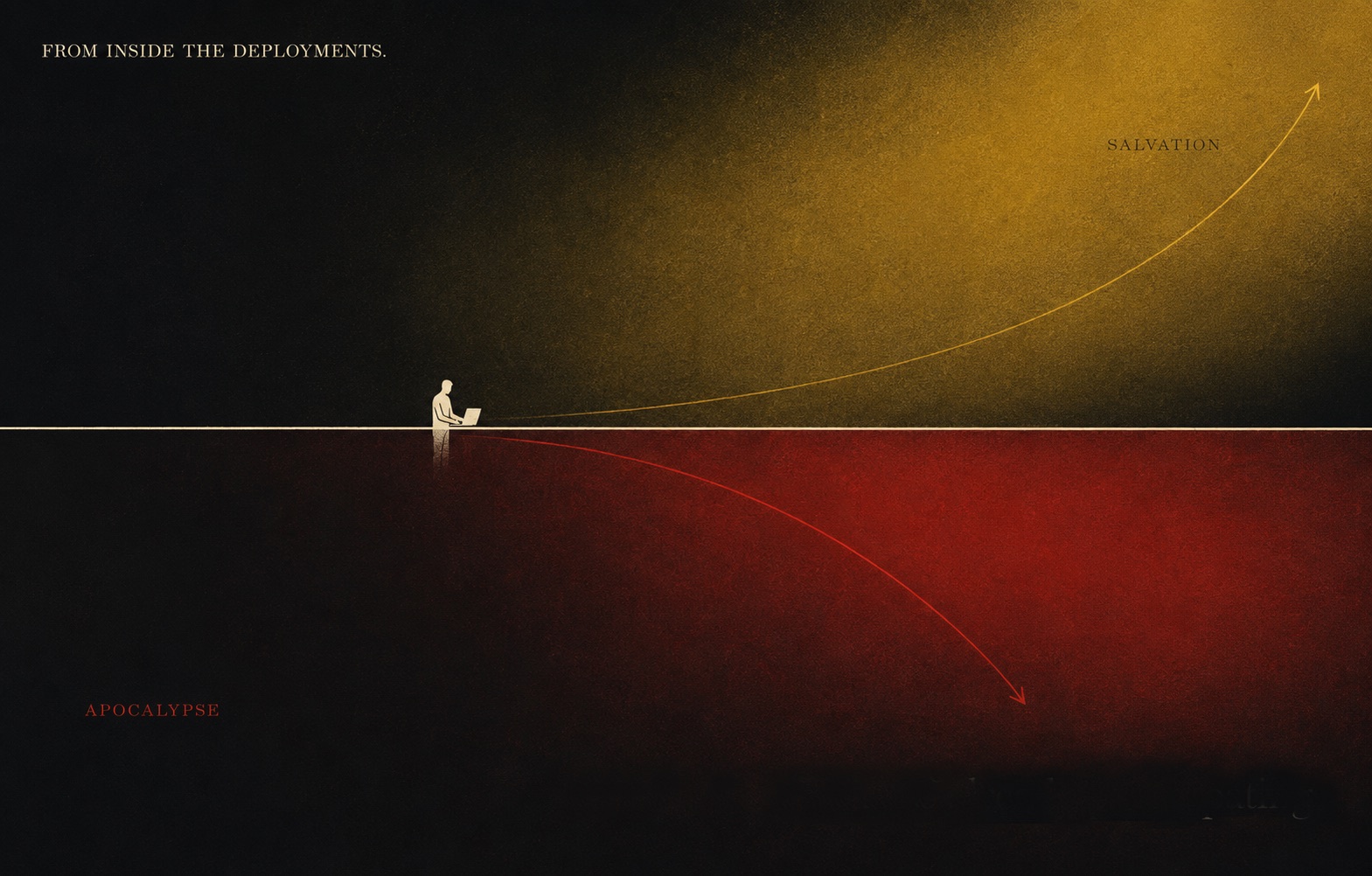
What I have is the conviction, which I cannot fully defend but which I cannot get rid of either, that the people who navigate this well are going to be the people who refuse the easy postures. Not the evangelists. Not the refuseniks. Not the people who treat AI as either salvation or apocalypse. The ones who do well are going to be the ones who stay close to the work, hold their conclusions loosely, refuse to flatten the costs, refuse to flatten the benefits, and act, in the small daily way that anyone actually acts, as if the people on the other side of the deployments are people whose lives matter.
This is not a recipe. It is barely even an argument. It is just the thing I keep arriving at when I think about the woman on that call, and the team that used to do the work, and the next deployment, and the one after that.
The honest version of what I want to say is something like this. The wave is real, the costs are real, and you are not allowed to ignore either one. The job is not to figure out whether to participate. You are already participating. You participate every time you open your laptop. The job is to participate as someone who remembers what is at stake, and to refuse, as much as you can manage, the comforts of pretending you aren't.
That is going to look different for different people. For me, right now, it looks like writing this down.